The platform

The engine behind everything we deliver.

Proprietary software, built for island property. It is what lets us fulfil agency work at a fraction of the usual cost - and what your team logs into when you'd rather run it yourself.
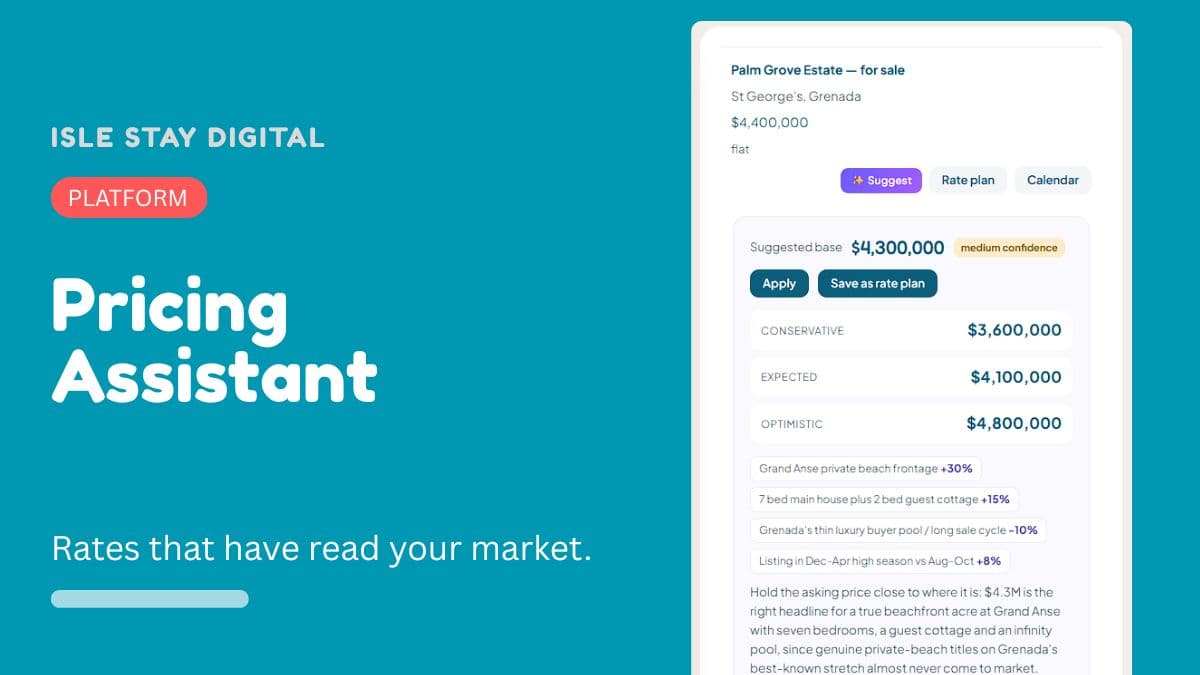
The Pricing Assistant suggesting a base price with conservative, expected and optimistic bands and reasoning tags01Pricing Assistant

Rates that have read your market.

Property size, walkability, beachfront status, bedroom count and hyper-local demand become a base rate with off-season, shoulder and peak plans - each with reasoning tags, and none of it applied until you say so.Read more →
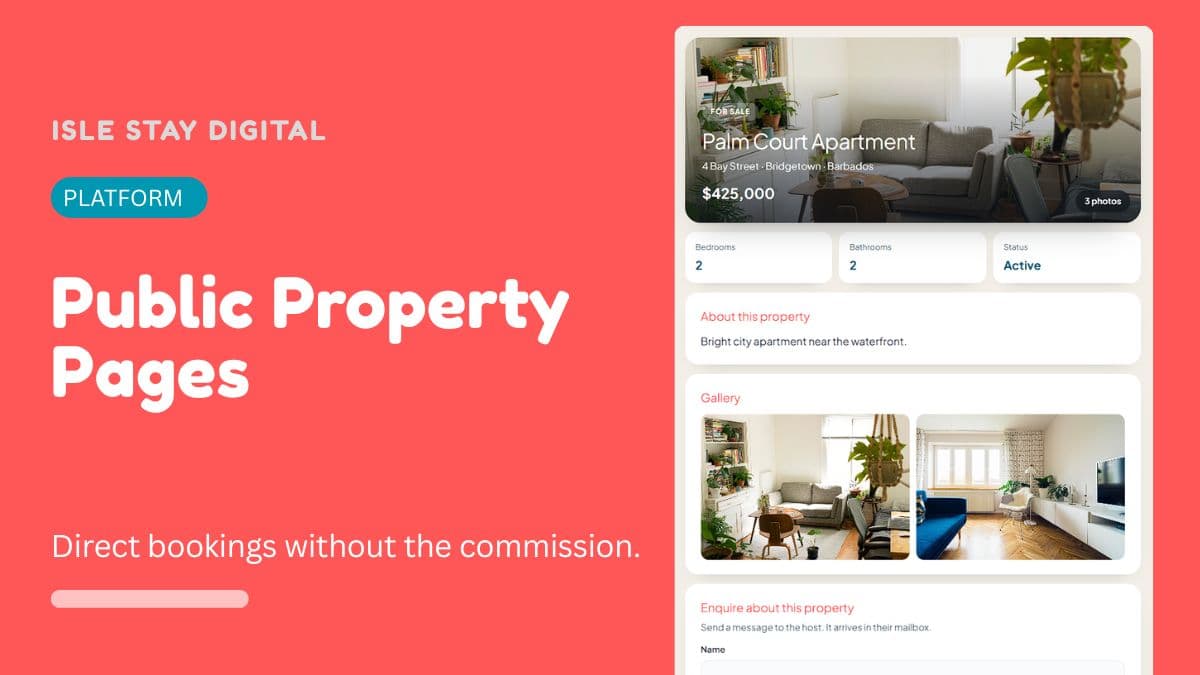
A public property page with gallery, specification and an enquiry form02Public property pages

Direct bookings without the commission.

Every property gets a high-converting public page - gallery, amenities, specification, host contact card and an enquiry form that lands in the mailbox and the CRM with the property attached.Read more →
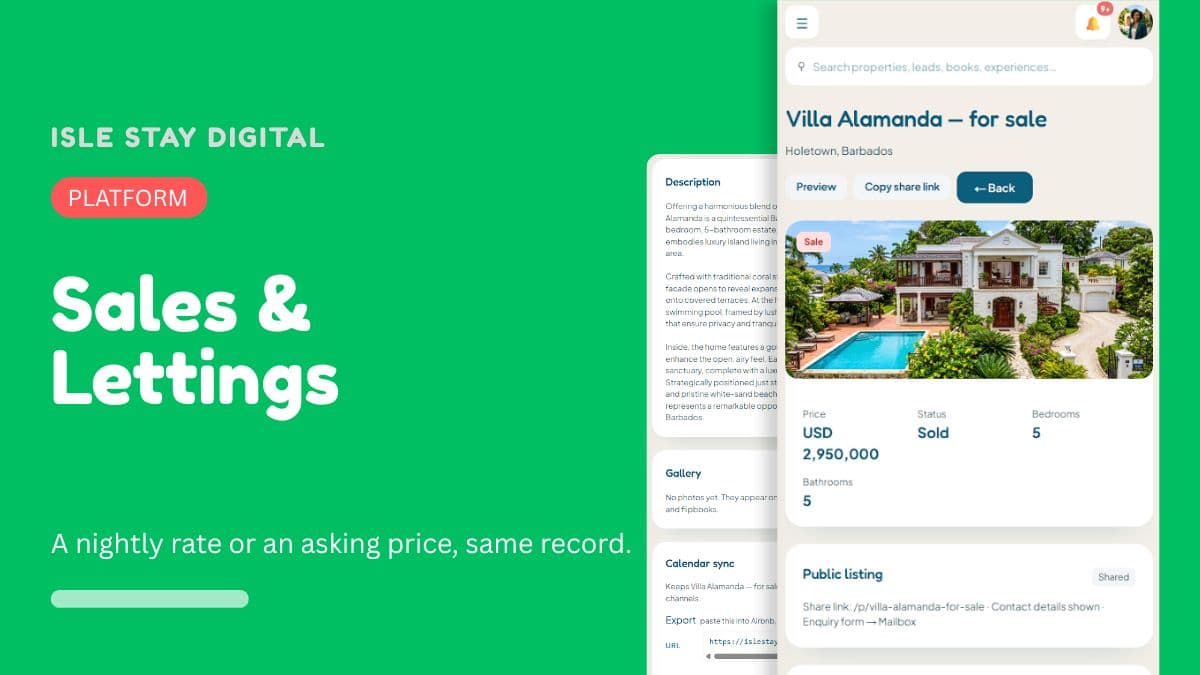
A property record for a villa listed for sale, with price, status and a public share link03Sales & rentals

A nightly rate or an asking price, same record.

Isle Stay is not only for holiday rentals. A property carries a deal type - for rent or for sale - and the same listing, enquiry and collateral tooling serves both, so an agency running rentals and sales works in one place instead of two.Read more →
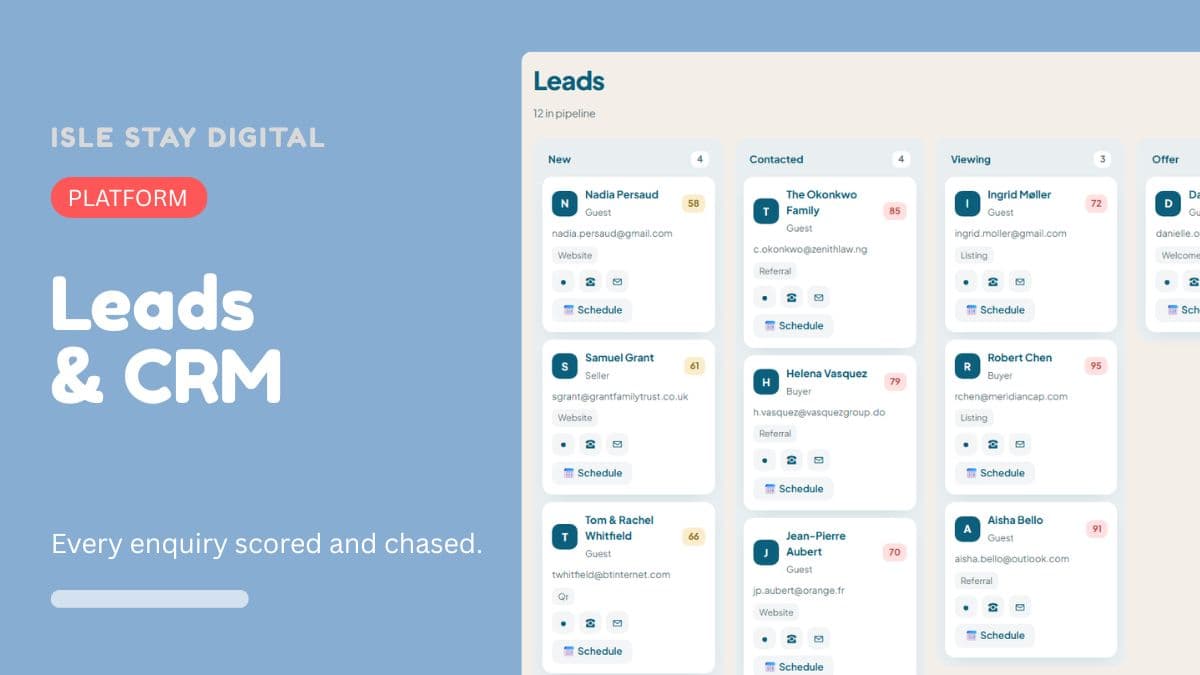
The leads board with new, contacted, viewing and offer columns, each lead scored04Leads & CRM

Every enquiry scored and chased.

Enquiries are categorised by intent - new enquiry, viewing scheduled, direct offer - so high-value opportunities surface instantly, and each one stays threaded to its property through to close.Read more →
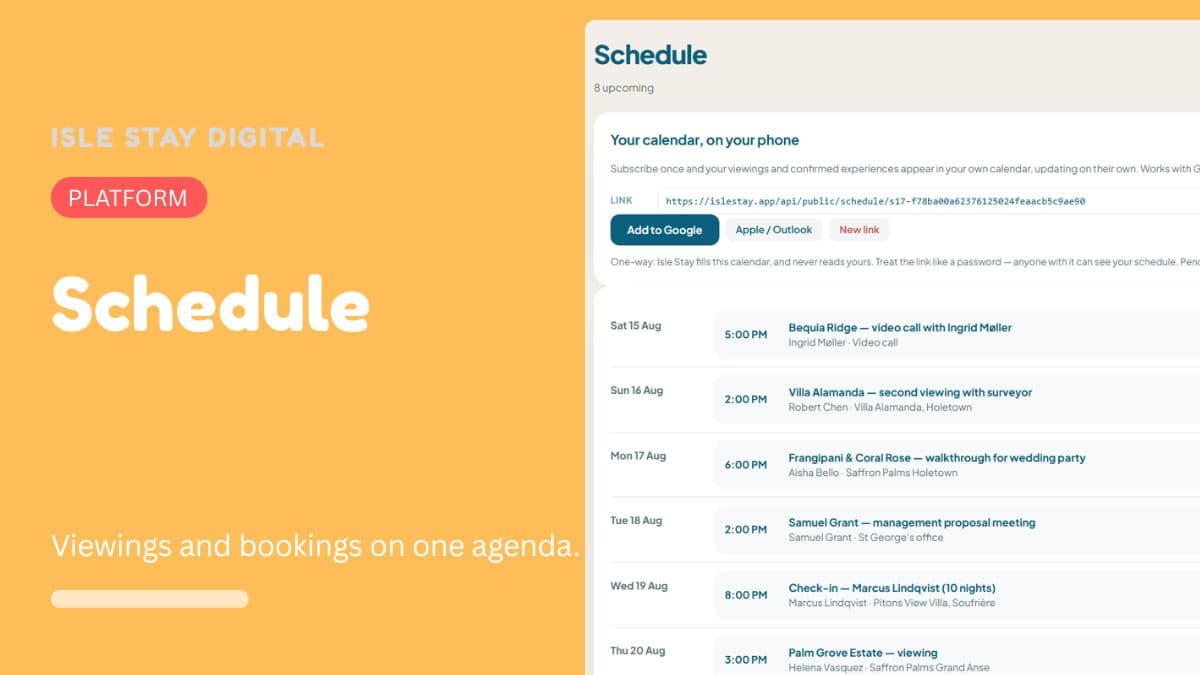
The schedule of upcoming viewings and bookings, with its calendar subscription link05Schedule

Viewings and bookings on one agenda.

Viewings, calls and confirmed experiences on a single schedule - and subscribable, so the same agenda appears in the calendar your team already lives in rather than in a tab they have to remember to open.Read more →
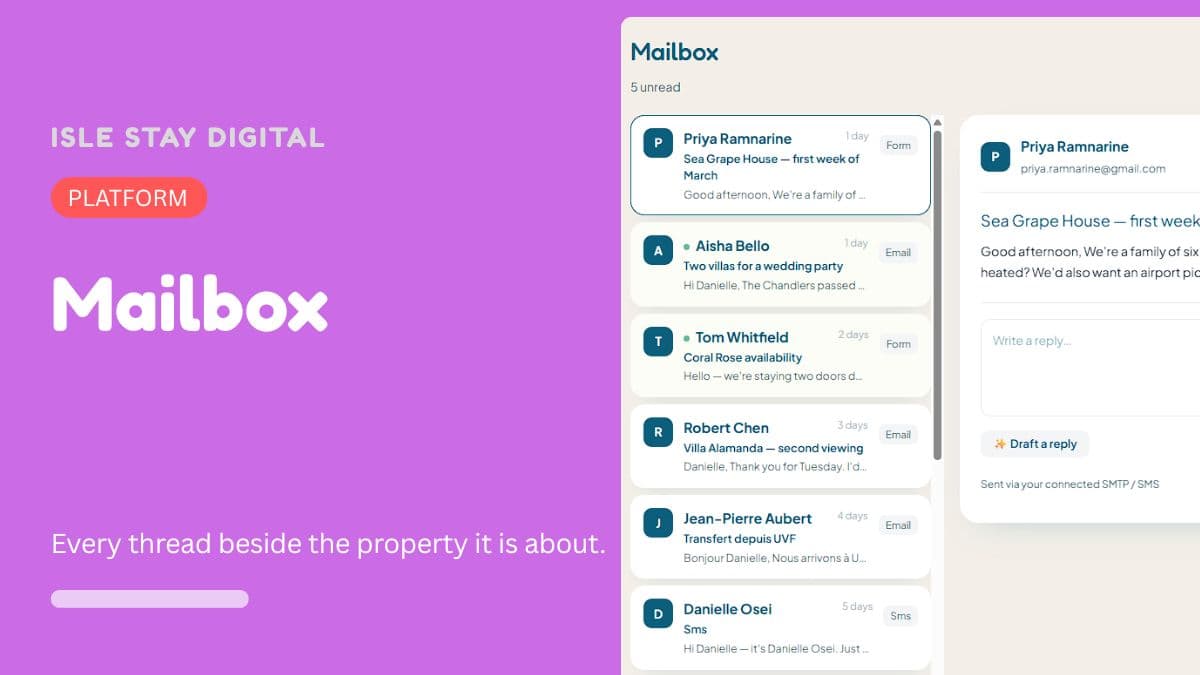
The mailbox with guest and buyer threads beside a reply pane06Mailbox

Every thread beside the property it is about.

Guest, buyer and vendor messages in one mailbox, each one threaded to the lead who sent it and the property it concerns - so nothing is lost between an enquiry form, a QR scan and somebody's personal inbox.Read more →
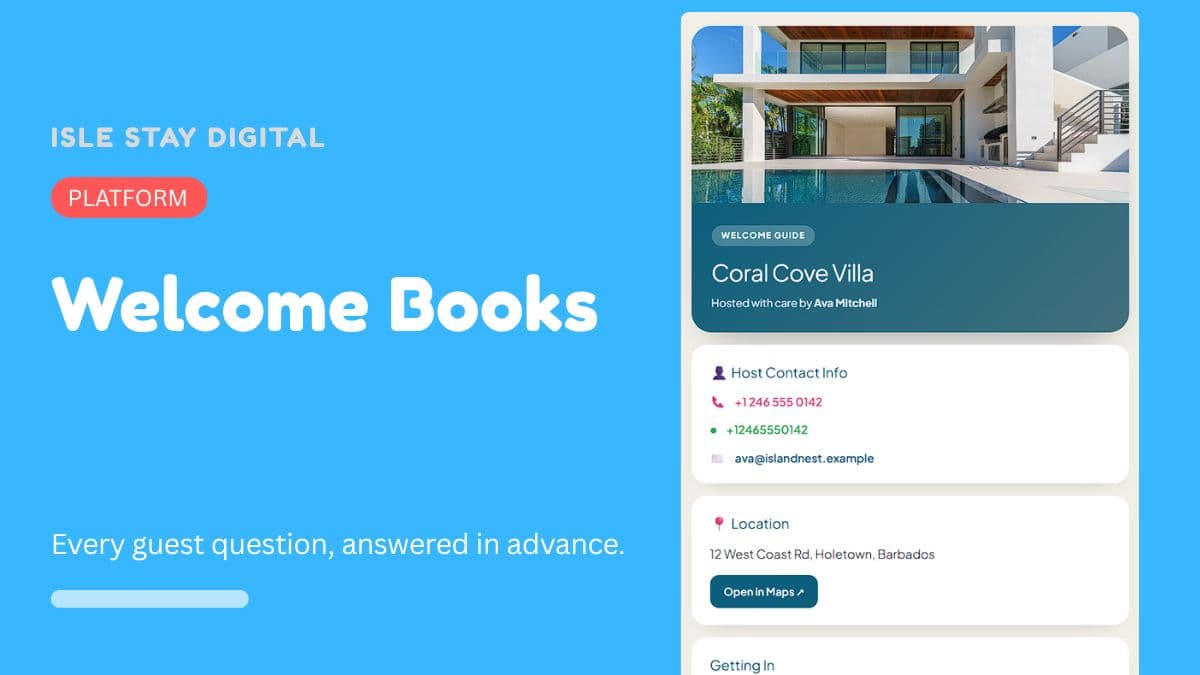
A property welcome guide showing host contact, location and getting in07Welcome books

Every guest question, answered in advance.

Host contact, maps, getting in, Wi-Fi, house rules and local recommendations - written once, published as a branded link, duplicated to the next property in a click.Read more →
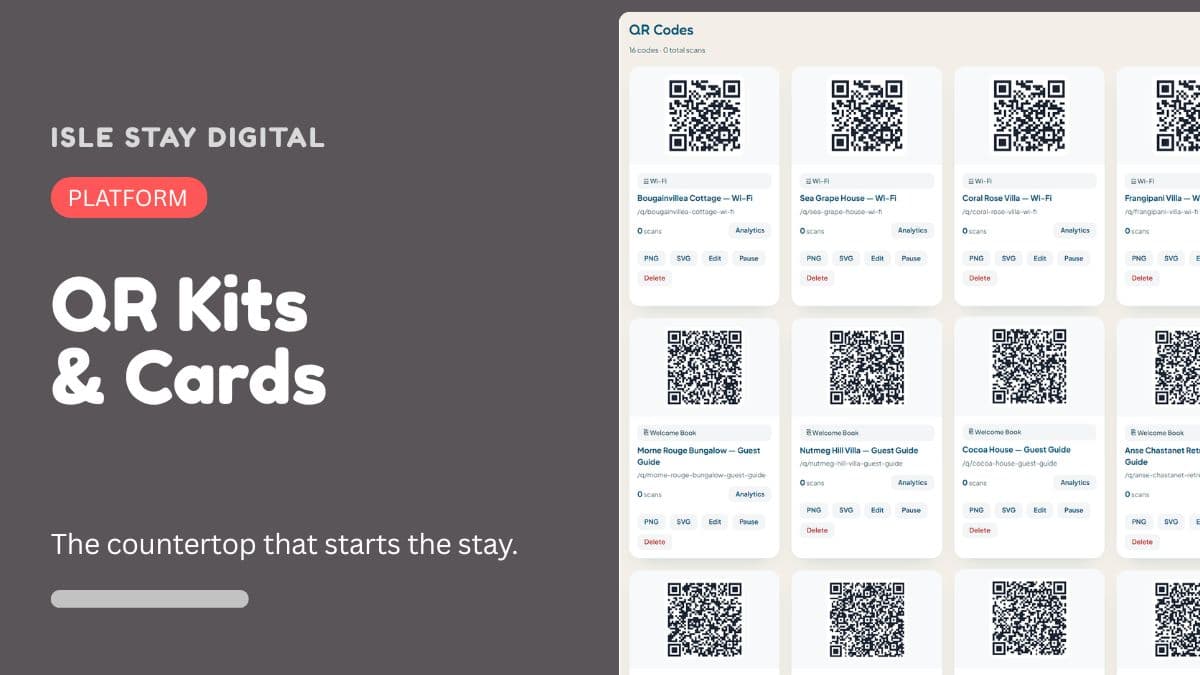
A grid of generated QR codes for Wi-Fi and guest guides, each with its scan count08QR codes & cards

The countertop that starts the stay.

Codes for every job, placed where they earn - Wi-Fi by the router, the guide on the fridge, concierge by the door, a listing in an agent's pocket. Download as PNG or SVG and print them on whatever you like. Scans are counted.Read more →
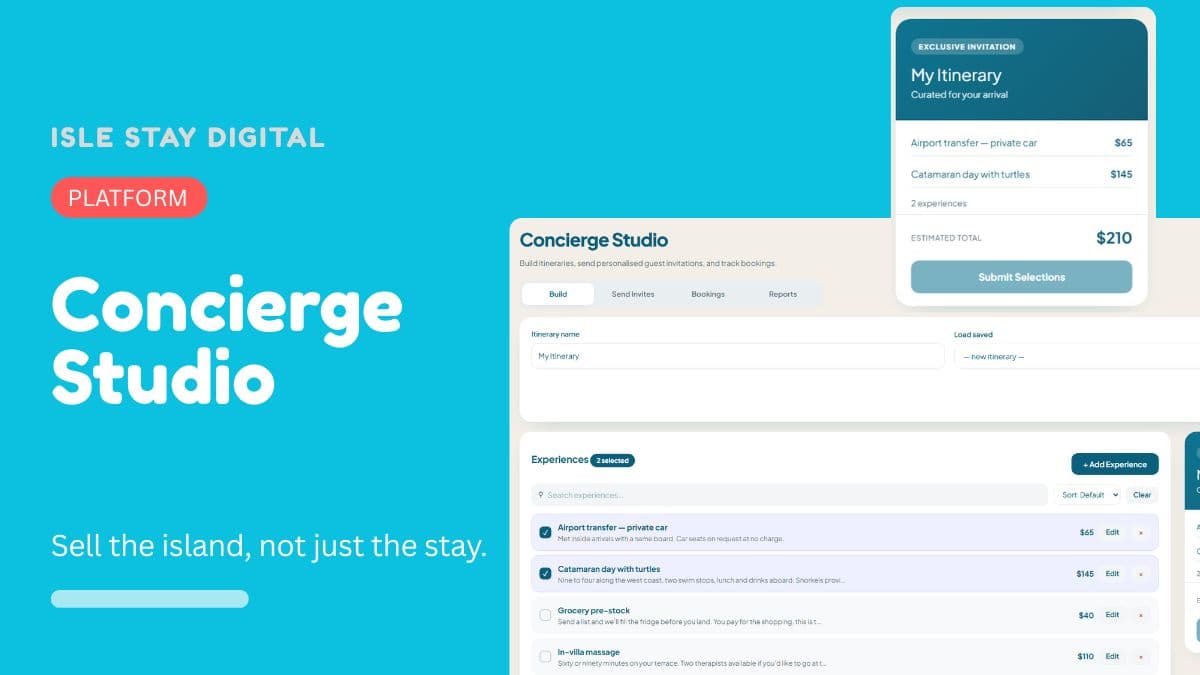
Concierge Studio building an itinerary beside the guest invitation it produces09Concierge Studio

Sell the island, not just the stay.

Build itineraries from partnered local operators, send them as personal invitations before arrival, take the booking inside the invitation and earn affiliate commission on every experience.Read more →
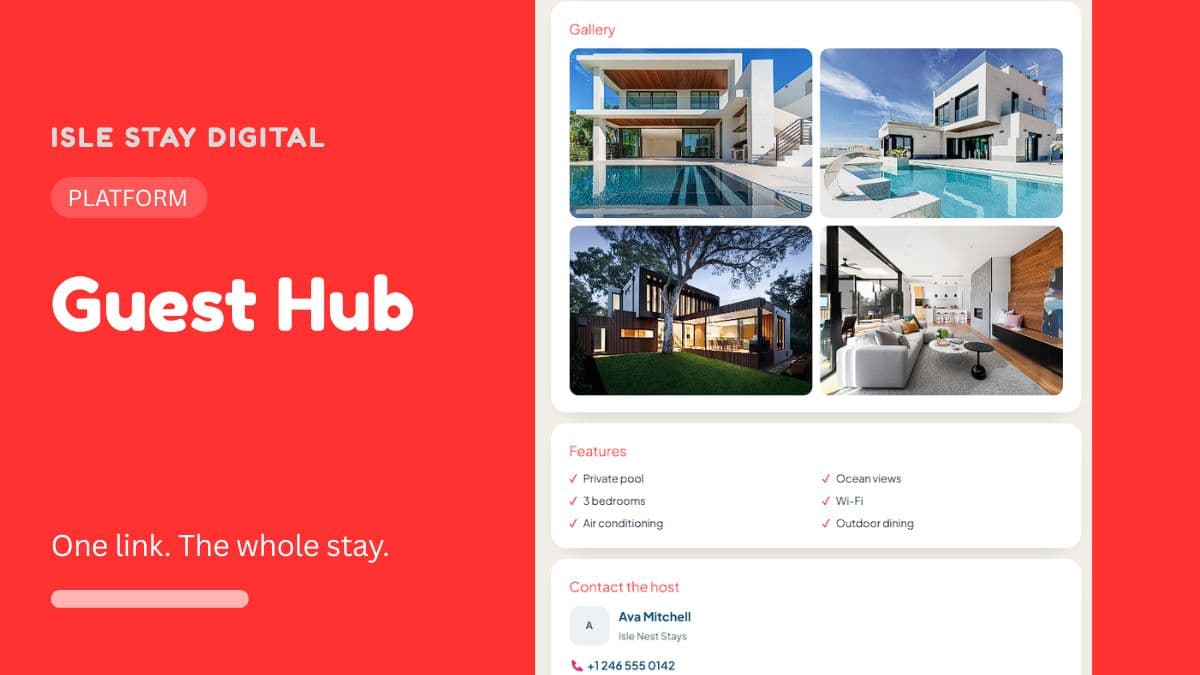
The guest hub with gallery, features and host contact on one link10Guest hub

Everything they need, on the fridge.

A QR opens the guide in any browser - no store, no login, no app to explain. Wi-Fi, entry, check-out, island tips and whatever else you keep repeating, in their hand from the moment they walk in.Read more →
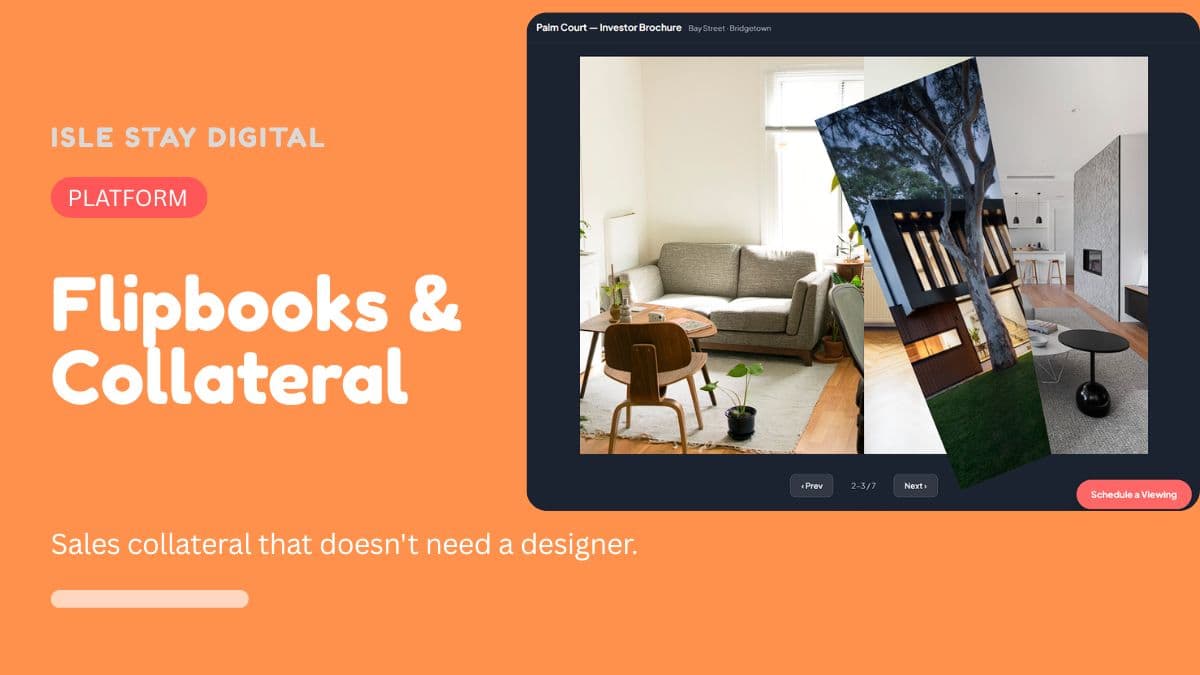
A branded investor brochure flipbook mid page-turn11Flipbooks & collateral

Sales collateral that doesn't need a designer.

Branded digital flipbooks for direct-booking pitches and property sales - portfolio decks, unit brochures, agent cards - built from the listings already in the workspace.Read more →
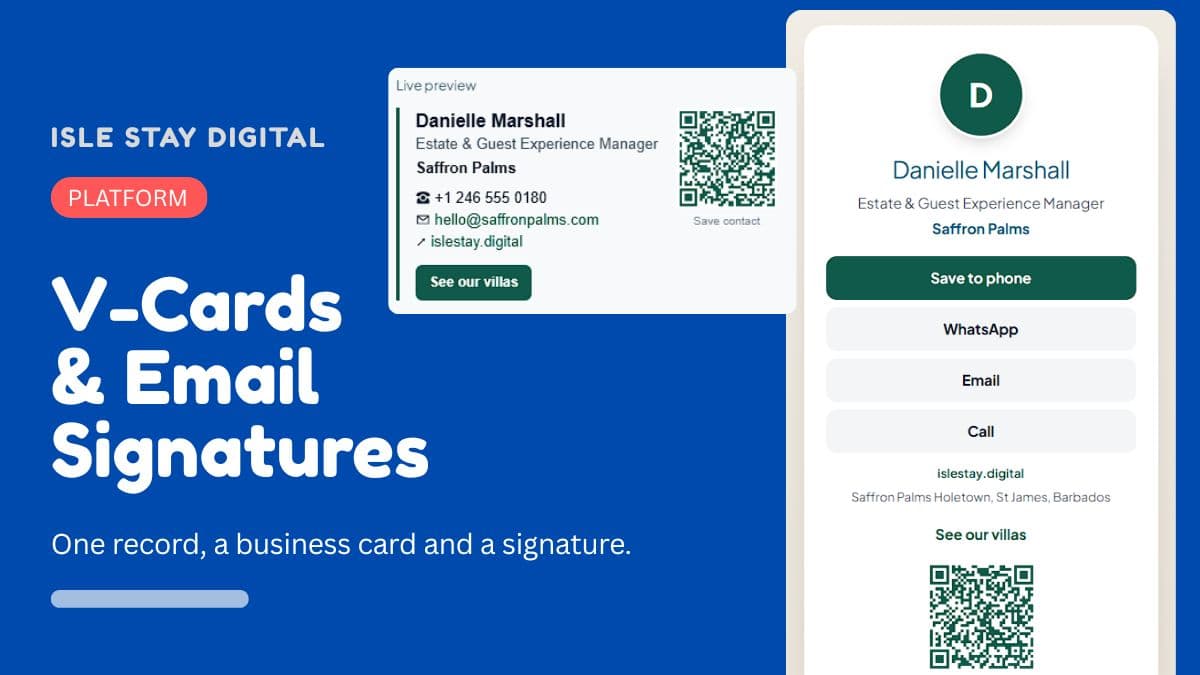
A digital business card and the matching email signature, both carrying a save-contact QR12Cards & signatures

One record, a business card and a signature.

Fill in a person once - name, title, contact, photo, a call to action - and get a shareable digital business card and a branded email signature carrying a trackable QR that opens it. No designer, no HTML, no version that is three job titles out of date.Read more →
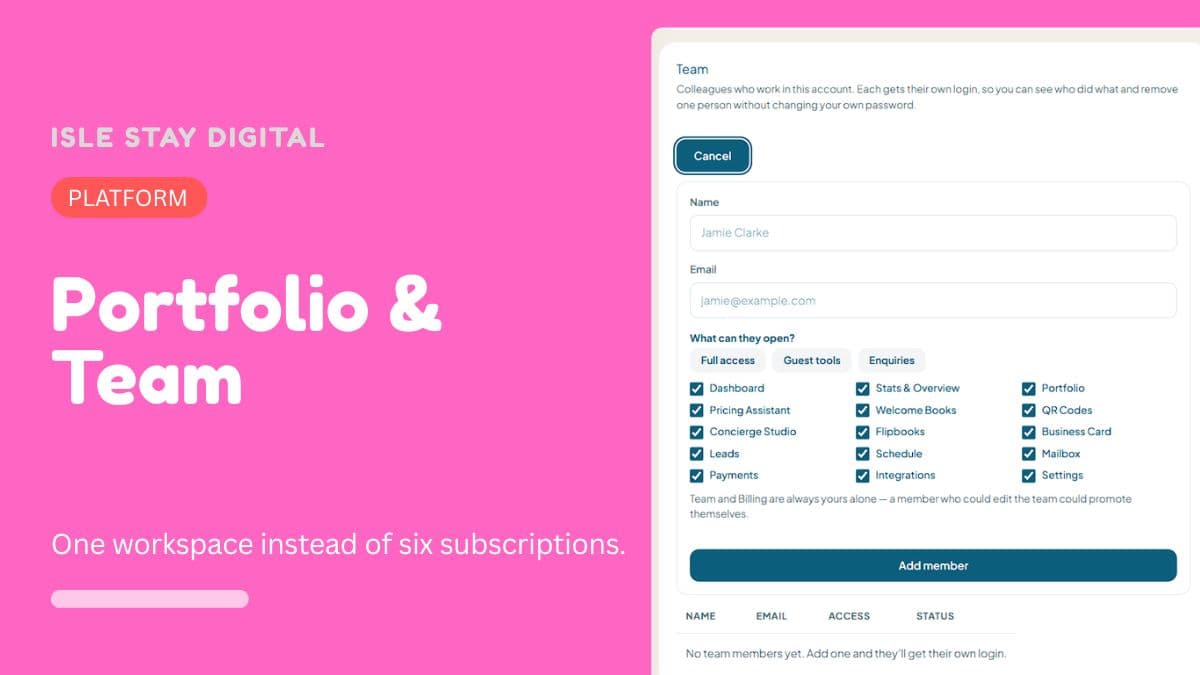
Team access controls granting each colleague specific parts of the workspace13Portfolio & team

One workspace instead of six subscriptions.

Properties, calendars, welcome books, QR codes, concierge, leads, schedule, mailbox, payments and team roles in a single system - with a daily briefing that tells whoever logs in where to start.Read more →
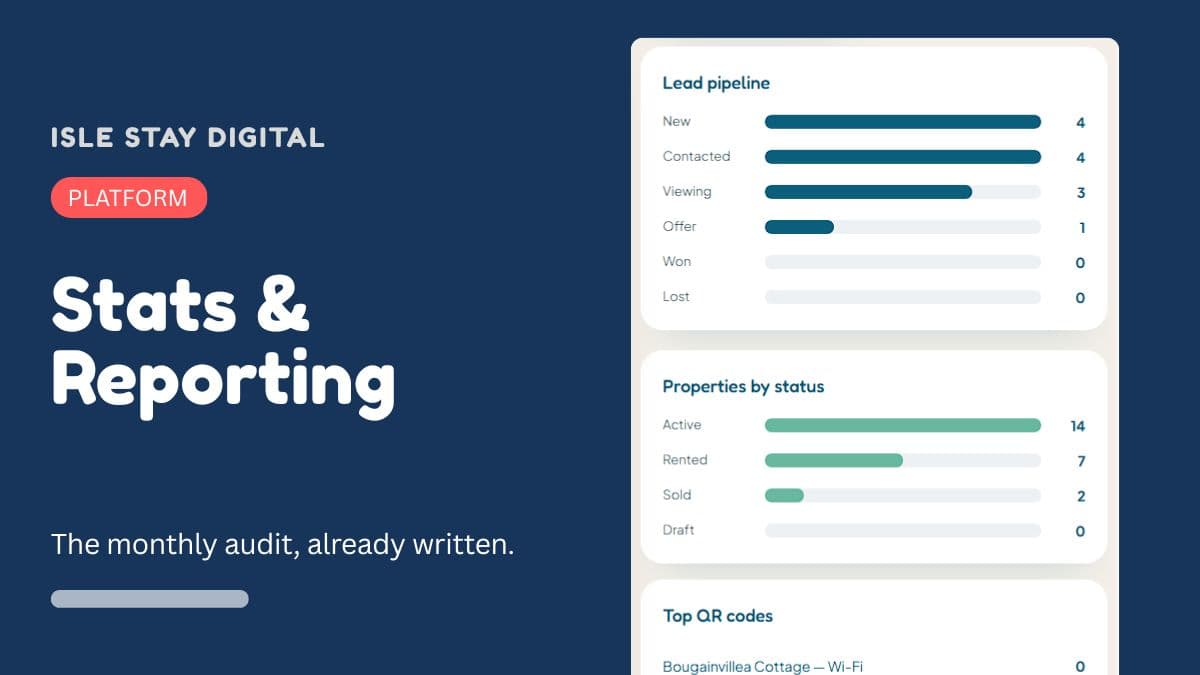
Reporting: lead pipeline, properties by status and top QR codes14Stats & reporting

The monthly audit, already written.

Direct revenue generated, occupancy, QR scans and upsell engagement, active guest leads and experience revenue - the numbers that make the owner conversation short.Read more →
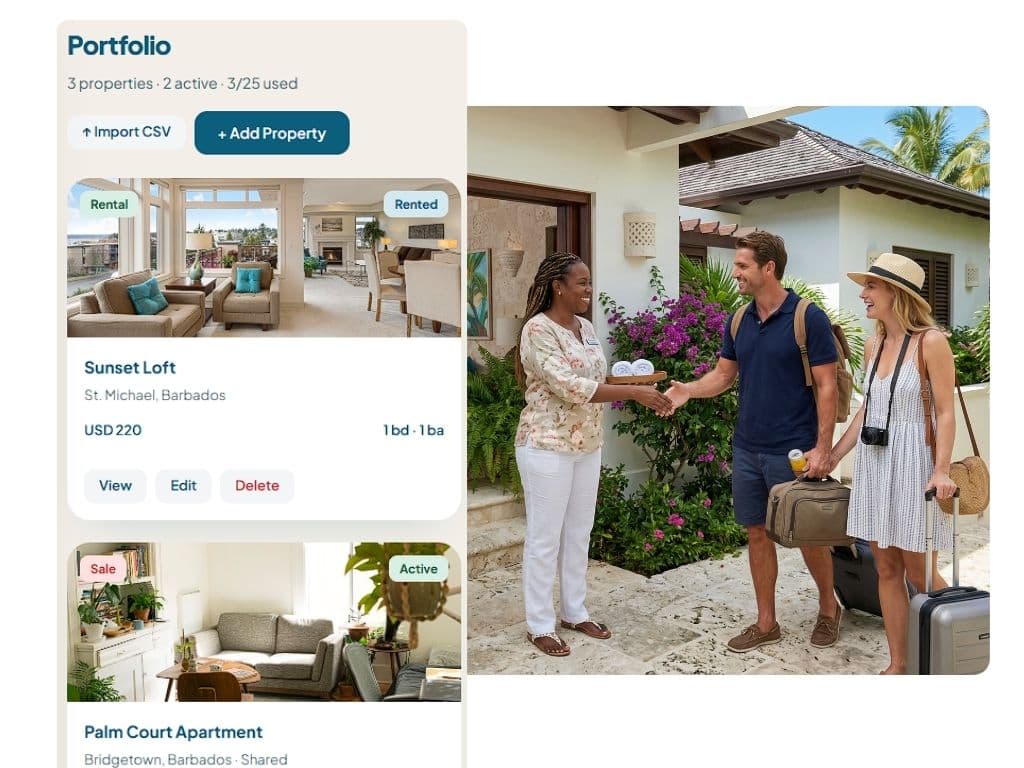
A guest checking their phone on arrival at a villa15Guest assistant

Answers the questions you keep answering.

A chat assistant that knows your listings and whatever else you tell it - check-in times, the parking, whether you take dogs. Share it as a link or drop one line into your own website. It never confirms a booking, because it cannot see your calendar.Read more →

Free to start on your own listings.

Listings & guest storefront, welcome books and QR codes cost nothing.

How the tools actually work

The questions we are asked most about what each part does, and where its edges are.

It reads the property record: how many bedrooms it has, how many it sleeps, where it is, how close that is to a beach, whether the area is somewhere visitors already go, and the seasonality of that market. It returns a suggested base rate, a low, mid and high range around it, a short written rationale and a confidence level.Which means the quality of a suggestion is the quality of your listing. A property with bedrooms and location left blank gets a vague answer, and it says so: confidence comes back low rather than inventing precision. Two things it will never do are convert currency and apply anything on its own. A suggestion stays a suggestion until you accept it.
Every published property page carries an enquiry form. When somebody sends one, three things happen at once: a lead is created against that property, the message itself is filed, and you get an email so you do not have to be logged in to find out.The lead and the message are two views of the same enquiry. The lead is the person and how far they have got; the message is the conversation. Nothing routes through a channel, so the guest's contact details are yours from the first message rather than released to you after a booking.
A welcome book is one web page a guest opens on arrival. It holds the practical things: the wifi network and password, entry instructions, check-out time, an address with a map link, an emergency contact, and as many custom sections as you want for the questions you find yourself repeating.You can protect it with an access code, which is worth doing when it contains a door code or an alarm. You can also set it to expire a number of days after a guest first opens it, so last season's visitors keep their memories without keeping your wifi password. There is an option to email you the moment a book is opened, which is the quickest way to know a guest has arrived.
Most codes route through a short link, so you can see total scans, unique visitors, the kind of device and which days they were scanned. That is how you learn the code in the guest folder is being ignored while the one on the fridge is doing all the work. You can also repoint a tracked code at something new without reprinting anything.The Wi-Fi code is the exception and cannot be tracked, because a wifi code has to contain the network name and password themselves for a phone to join, so there is nothing to route through a link. Download the SVG rather than the PNG for anything printed: it stays sharp at any size, and a soft-edged code is one that takes three attempts to scan in poor light.
You build a list of experiences once, each with a price, a rough duration and the days it runs, then curate a few of them into an invitation for one particular guest. The guest gets a private page with your welcome message and only the things you picked. A list of forty is a catalogue and gets ignored; five chosen for a couple arriving on their anniversary gets booked.When a guest selects something it lands in your bookings and you confirm or decline. That step is deliberate, because availability on an island moves, and a guest told a thing is confirmed by software that has not spoken to the boat captain is a worse outcome than one asked to wait an hour. Payment instructions appear only after you confirm, so nobody is invited to pay for something that might be declined.
It works in both directions and you need both halves. You import each platform's calendar so clashes are visible here, and you give each platform your Isle Stay feed so anything blocked here blocks there. Set up only the import and you see the clash after it has happened; set up only the export and the other platforms never learn about each other.The honest limitation is that iCal is polling, not messaging. Every platform refreshes on its own schedule, usually every few hours, so a same-day booking can still slip through. A Sync now button forces a fetch on our side, but nothing can force another platform to fetch from us. If double bookings are a commercial risk rather than a nuisance, a channel manager is the right tool for that and we will say so.
It knows your published listings from the start, and you add whatever else guests ask about: check-in times, parking, whether you take dogs. You can share it as a link or paste one line into your own website to put a chat bubble in the corner of every page. It answers as your business and never mentions the software behind it.It will not confirm a booking or hold dates, because it cannot see a live calendar. Asked to, it takes the details as an enquiry and says someone will confirm. It also will not promise a discount, an upgrade or an early check-in, since those are yours to give. Anything it cannot answer from what you have told it, it passes on rather than guessing.
The property page sells the place to somebody deciding: photographs, description, amenities and an enquiry form. The welcome book helps somebody who has already arrived and wants the wifi password. They are different jobs for different moments, which is why they are separate pages rather than one long one.They are connected where it helps. If you have published experiences, the welcome book links through to your concierge catalogue, so a guest who scanned the code on the fridge can see what else you offer without you having to print a second code.
Every account picks a name that becomes its Isle Stay address, and your public pages live there. Choose it carefully: it ends up on printed cards, in QR codes and in guests' bookmarks, so changing it later breaks all of them. Pick the business name rather than a property name, because the business name still works when you add a fourth villa.You can also point a domain you already own at your public pages, including a subdomain like stay.yourbusiness.com if your main site lives elsewhere. You add one DNS record and the secure certificate is issued automatically. Sign-in always stays on Isle Stay, so your own domain serves guests rather than the workspace.
Yes. Access is granted per section rather than by job title, so somebody handling arrivals can have welcome books and QR codes while the CRM simply is not there for them. They set their own password from an invite link, which means nobody has to share a login to get started, and removing one person does not lock out everybody else.Two areas are owner-only and cannot be granted to anyone: the team itself and billing. That is not about trust. Somebody who could edit the team could promote themselves, and somebody who could edit billing could change what you pay, so the option does not exist rather than existing and being discouraged.