
How pricing works
Base rate, seasons and the extras that sit on top - and what the Pricing Assistant is actually reading when it suggests a number.
Last updated
Pricing in Isle Stay is one number with adjustments layered on it. Understand the layers and the rest is quick.
The Pricing Assistant is on the Pro plan and above. Everything else on this page - base rate, seasons, fees - works on every plan.
The base rate
One nightly figure, in a currency you choose per property. It is the number everything else adjusts.
Set it to what you would charge on an ordinary week in an ordinary month. Not your best week, not your worst. Seasons handle the rest.
Seasons
A season is a name, a start date, an end date and a rate. They override the base rate for the dates they cover.
Most island properties want three:
- Peak - roughly mid-December to mid-April in the Caribbean
- Shoulder - the weeks either side
- Off-season - August to October, which is hurricane season and soft almost everywhere
You can add as many as you like, and name them whatever makes sense to you. There is nothing magic about three.
For a single date that does not fit any season - a regatta, a festival, a wedding weekend - use a date override instead of inventing a two-day season.
The adjustments
These sit on top of whatever rate applies:
- Weekend uplift - a percentage added to Friday and Saturday nights
- Weekly and monthly discounts - a percentage off longer stays
- Early bird and last minute - percentages off for booking well ahead, or very late
- Minimum stay - nights, enforced on the enquiry form
- Cleaning fee - a flat amount, separate from the nightly rate
- Commission and tax - percentages, for working out what actually reaches you
The last two do not change what a guest is quoted. They exist so your own numbers are honest about what you keep.
What the Pricing Assistant reads
Open Pricing on a property and ask for a suggestion. It gives you a base rate, a low–mid–high range, a short rationale and a confidence level.
It reads what the property record actually contains:
- Bedroom count and how many it sleeps
- Where it is, and how close that is to a beach
- Whether the location is somewhere tourists already go
- The seasonality of that market
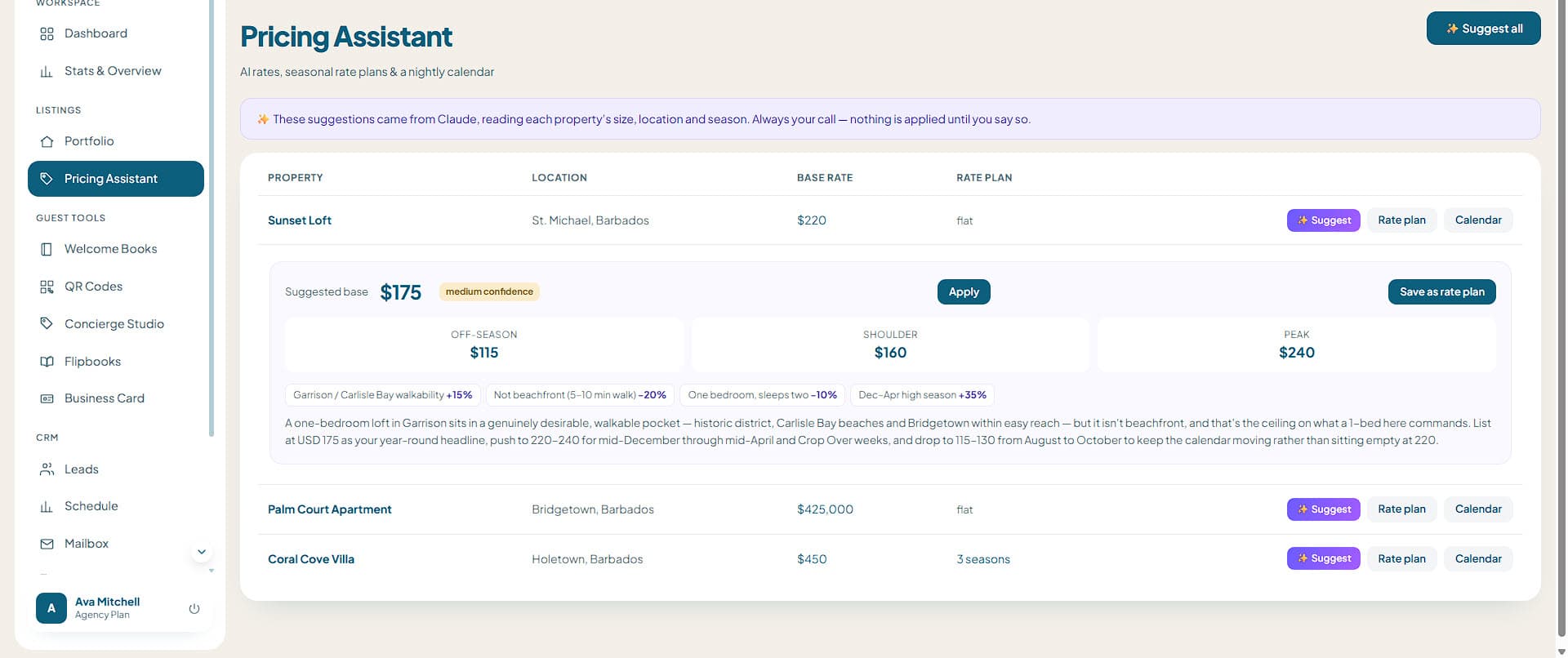
Which means the quality of the suggestion is the quality of your property record. A listing with bedrooms and location left blank gets a vague answer, and it will say so - confidence comes back low rather than inventing precision. If a suggestion looks wrong, the first thing to check is what you have told it.
Two things it deliberately will not do: it never converts currency, and it never applies anything on its own. A suggestion is a suggestion until you accept it.
Rentals come back per night, rounded to the nearest 5. Properties listed for sale come back as a total asking price, rounded to the nearest 1,000.
Sanity checks worth doing
Does the low end still make money? Work out the cleaning fee, commission and tax against the low figure, not the mid. If the answer is unpleasant, your base is too low regardless of what anything suggests.
Is your peak actually peak? Look at when you were full last year rather than when the calendar says high season. Markets differ by island and sometimes by parish.
Have you priced the minimum stay honestly? A three-night minimum with no weekly discount quietly turns away the longer bookings that are cheapest to service.
Common questions
Can I have different currencies per property? Yes - currency is set on each property, not on the account.
Does changing the base rate change my seasons? No. Seasons hold their own rate. If you want everything to move, change them too.
Why is my published price different from my base rate? A season, a weekend uplift or a date override is covering that date. Open the rate plan and look at the date itself.
Still stuck?
If a guide does not cover it, open Help & Support inside your hub. It comes through with the page you were on and your plan attached, so you can just describe what happened.
Sign in and ask